Pages

Showing posts with label Full Movie. Show all posts

Saturday, February 27, 2010

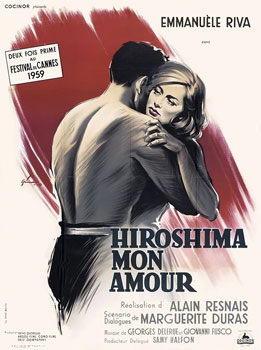
Hiroshima Mon Amour (1959)

Hiroshima Mon Amour is an acclaimed 1959 drama/romance film directed by French film director Alain Resnais, with a screenplay by Marguerite Duras. It is about a relationship between a French woman and a Japanese man. It was one of the first French New Wave films and made innovative use of flashbacks.

Synopsis
Hiroshima Mon Amour concerns the experiences of a French actress (Emmanuelle Riva), referred to as Elle (she), who performs the role of a nurse in a film being shot in post-war Hiroshima. She meets a Japanese architect (Eiji Okada), referred to as Lui (him) and, separated from their spouses, they become lovers. The early part of the film recounts, in the style of a documentary, but narrated by the so far completely unidentified characters, the effects of the Hiroshima bomb on August 6, 1945, in particular the loss of hair and the complete anonymity of the remains of some victims. The man had been conscripted into the Japanese army, and his family were in Hiroshima on that day.

Monday, February 22, 2010

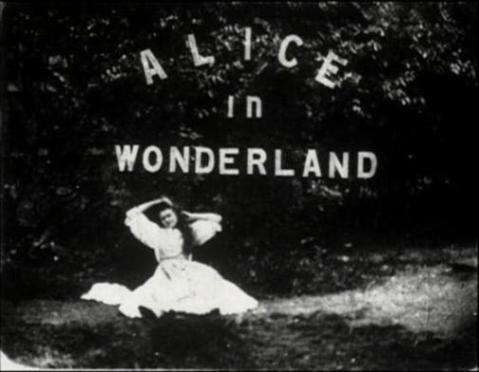
Alice in Wonderland (1903)

The first-ever film version of Lewis Carroll's tale has recently been restored by the BFI National Archive from severely damaged materials. Made just 37 years after Lewis Carroll wrote his novel and eight years after the birth of cinema, the adaptation was directed by Cecil Hepworth and Percy Stow, and was based on Sir John Tenniel's original illustrations. In an act that was to echo more than 100 years later, Hepworth cast his wife as the Red Queen, and he himself appears as the Frog Footman. Even the Cheshire cat is played by a family pet.

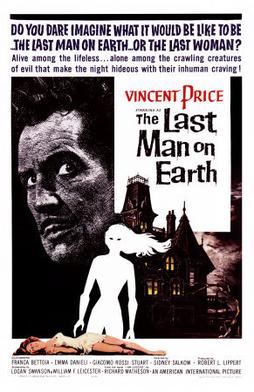
The Last Man on Earth (1964)

Based on the chilling Richard Matheson science fiction classic story I am Legend and later remade as The Omega Man (1971) starring Charlton Heston, and the last one I am Legend (2007) starring Will Smith. 

This classic features Vincent Price as scientist Robert Morgan in a post apocalyptic nightmare world. The world has been consumed by a ravenous plague that has transformed humanity into a race of bloodthirsty vampires. Only Morgan proves immune, and becomes the solitary vampire slayer.


Wuthering Heights (1939)

The earliest known film adaptation of Wuthering Heights was filmed in England and directed by A. V. Bramble. It is unknown if any prints still exist.

The most famous was 1939's Wuthering Heights, starring Laurence Olivier and Merle Oberon and directed by William Wyler.


This adaptation, like many others, eliminated the second generation's story (young Cathy, Linton and Hareton). It won the 1939 New York Film Critics Circle Award for Best Film and was nominated for the 1939 Academy Award for Best Picture.

Nosferatu (1922)

Originally released in 1922 as Nosferatu, Eine Symphonie Des Grauens, director F.W. Murnau's chilling and eerie adaption of Stoker's Dracula is a silent masterpiece of terror which to this day is the most striking and frightening portrayal of the legend.


Sunday, February 21, 2010

Frankenstein (1910, Full)

Frankenstein is a 1910 film made by Edison Studios that was written and directed by J. Searle Dawley. It was the first motion picture adaptation of Mary Shelley's Frankenstein. The unbilled cast included Augustus Phillips as Dr. Frankenstein, Charles Ogle as the Monster, and Mary Fuller as the doctor's fiancée.

Shot in three days, it was filmed at the Edison Studios in the Bronx, New York City. Although some sources credit Thomas Edison as the producer, he in fact played no direct part in the activities of the motion picture company that bore his name.

Monday, December 24, 2007

Fahrenheit 451, François Truffaut (Full Movie)


to read the information about movie please click here.

Saturday, December 22, 2007

The Picture of Dorian Gray, 1945 (Full Movie)

The movie is divided in to several parts. You can see and watch the parts by clicking on "MENU" button.

Tuesday, December 11, 2007

Rashomon (Full Movie)


Rashomon is a 1950 Japanese film directed by Akira Kurosawa, working in close collaboration with cinematographer Kazuo Miyagawa. It stars Toshirō Mifune, Machiko Kyo and Masayuki Mori. The film is based on two stories by Ryūnosuke Akutagawa ("Rashomon" provides the setting, while "In a Grove" provides the characters and plot). Rashomon can be said to have introduced Kurosawa and Japanese cinema to Western audiences, and is considered one of his masterpieces.

The film has an unusual narrative structure that reflects the impossibility of obtaining the truth about an event when there are conflicting witness accounts. In English and other languages, 'Rashomon' has become a byword for any situation in which the truth of an event is difficult to verify due to the conflicting accounts of different witnesses. In psychology, the film has lent its name to the 'Rashomon effect'.


Sunday, September 30, 2007

All Quiet on the Western Front-1930 (Full movie)


All Quiet on the Western Front is an Academy Award-winning film based on the Erich Maria Remarque novel All Quiet on the Western Front. It was directed by Lewis Milestone, and stars Louis Wolheim, Lew Ayres, John Wray, Arnold Lucy and Ben Alexander.


Released in 1930, it is considered a realistic and harrowing account of war and World War I, and was named #54 on the AFI's 100 Years... 100 Movies. Also, in 1990, this film was selected and preserved by the United States Library of Congress' National Film Registry as being deemed "culturally, historically, or aesthetically significant."


Synopsis

The film opens with a military parade and a rousing speech by a schoolmaster convincing his young students to enlist and "save the fatherland". The young enlistees are then portrayed in basic training, aching for "action" fighting in the war. Their training officer tells them to forget everything they know, they are going to become soldiers. Rigorous training diminishes the recruits' enthusiasm some. But after little more than marching drills, suddenly the cadets are told they are "going up front".


Next the new soldiers arrive by train to the combat zone. It is mayhem with soldiers everywhere, incoming bombs and horse-drawn wagons racing around and rain. One in the group is killed before they even move away from the train. The new soldiers "fresh from the turnip patch" are assigned to a unit composed of older soldiers who are not exactly accommodating. The young soldiers are shocked to find out there is no food available at their post. They have not eaten since breakfast but their new unit has not had food for two days. They have sent out a scrounger to locate something to eat and he returns with a slaughtered hog. The young soldiers have to "pay" for their dinner with cigarettes.


"For the fatherland" the young soldiers unit is sent out on night duty. They travel packed into a flat cargo truck like sardines. The driver leaves them saying "If there's any of you left, there will be someone here to pick you up in the morning". The young recruits look longingly at the truck as it leaves. An experienced soldier gives the "schoolboys" some real world instructions, telling them how to deal with incoming shells, "When you see me flop, you flop. Only try to beat me to it". The unit is stringing wire and trying to avoid shells. Flares light up the night sky as the enemy tries to spot them, machine guns sound and a bombardment (heavy incoming shells) starts. A young soldier is blinded by shrapnel and runs around screaming. Most of the soldiers stay low in the trenches. When the truck arrives in the morning most of the unit has survived. More rain.


Back at the base (bunker in the trenches), the soldiers play cards and fight off the rats who eat their food and gear. The young soldiers are showing signs of great stress: nightmares, shaking uncontrollably, and screaming about the unrelenting bombs. A wall collapses and buries one of the recruits. No place is safe, not the front, not the base. There is no relief from the war. The celebratory parade already seems a distant memory. One recruit loses control, runs out of the trench and is injured. Some of the soldiers want to leave the trench and attack but the enemy seems to have superior firepower. When food finally comes, the men have to fight to get their share. Then they are overcome by rats and kill them with spades. Suddenly there is a break in the bombing and the men are ordered out to fight.


A loud rumbling can be heard as the enemy approaches and then more shells. Now the soldiers are in trenches with rifles ready as incoming shells move closer and closer. They can do nothing but wait and hope. Now the enemy is in view running toward the trenches, but the Germans hold their fire until the enemy is close. At least they have the advantage of being in trenches, the enemy is advancing over an open field. The Germans use machine gun fire and hand grenades and they rifles to mow down the enemy, quite effectively. The enemy suffers great losses but succeeds in entering the trenches where hand-to-hand combat with bayonets commences.


The enemy overruns the trenches and the Germans fall back, occupying bomb craters. The enemy is overwhelming now and the Germans fall back to a second row of trenches. German shells rain heavily on the enemy after which the Germans attack in hand-to-hand combat. The enemy has occupied the first row of trenches with machine gun positions and inflict heavy casualties on the Germans. The battle winds down. 70 of the 150 men in the unit have been killed. The cook is mad because he cooked for 150. (54 minutes)


Read more: http://en.wikipedia.org/wiki/All_Quiet_on_the_Western_Front_%281930_film%29

Monday, September 24, 2007

The Grapes of Wrath (1940, Full Movie )


The Grapes of Wrath is an American 1940 film directed by John Ford. It was based on the Pulitzer Prize winning 1939 novel, of the same name, written by John Steinbeck.


The screenplay was penned by Nunnally Johnson and executive produced by Darryl F. Zanuck.

The film is about an Oklahoma family, the Joads, who become migrant workers in California after losing their farm during the Great Depression in the 1930s. The motion picture also details their arduous journey across country to California.


The film premiered in New York City on January 24, 1940, and Los Angeles on January 27, 1940. The wide release date in the USA was March 15, 1940.


Plot

The film opens with Tom Joad (Henry Fonda) being released from prison and hitchhiking his way back to his family farm in Oklahoma only to find it deserted.


Tom finds an itinerant ex-preacher named Jim Casy (John Carradine) sitting under a tree by the side of the road. Tom remembers that Casy was the preacher who baptized him, but now Casy has "lost the call" and his faith. Casy leads him to find his family at Uncle John's place. His family is happy to see Tom and expain they have made plans to head for California in search of employment as their farm has been foreclosed by the bank.


The large Joad family of twelve leaves at daybreak, packing everything into an old and dilapidated modified truck in order to make the long journey to the promised land of California.

Image:Grapesimage142.jpgThe Joads travel Hwy. 66.


The trip along Highway 66 is arduous and it soon takes a toll on the Joad family. Weak and elderly Grampa is the first to die on their journey. After he dies, they pull over to the shoulder of the road, unload him, and bury him. Tom writes the circumstances surrounding the death on a page from the family Bible and places it on the body so that if his remains were ever found his death would not be investigated as a possible homicide.


They park in a camp and they meet a man, a returning migrant from California, who laughs at Pa's optimism about conditions in California and who speaks bitterly about his awful experiences in the West. He hints at what the Joads will soon find out for themselves.


The family arrives at the first transient migrant campground for workers and find the camp is crowded with other hungry, starving, jobless and desperate travelers. Their truck slowly makes its way through the dirt road between the shanty houses and around the camp's hungry-faced inhabitants. Tom says, "Sure don't look none too prosperous."

After some trouble with a "so-called" agitator, the Joad's leave the camp in a hurry.


The Joad's make way to another migrant camp named the Keene Ranch. After doing some work in the fields they discover about the high food prices in the company store for meat and other products. The problem is that the store is the only one in the area, by a long shot. Later they find there is a striking group of migrants in the camp and Tom wants to find out all about it. Tom goes to a secret meeting in the dark woods.


Image:Grapeswrath553.jpg
Ma and Tom Joad. Note Tom's scar on left cheek.

The meeting is discovered and Casy is killed by one of the guards. Tom defends Casy from the vicious attack and kills the attacking guard in retaliation.

During the altercation, Tom suffers a serious face wound on his cheek and the guard realizes it won't be difficult to identify him.

That evening the family hides Tom under the mattresses of the truck just as guards arrive to question them and search for the killer of the guard. Tom avoids being spotted and the family successfully leave the Keene Ranch without further incident.

At the top of a hill, the car runs out of gas, and they're able to coast into a third type of camp: a clean camp run by the USDA.

After Tom becomes personally idealized by what he has witnessed in the various camps, he describes how he will carry on Casy's mission in the world by fighting for social reform. Tom goes off to seek a new world, and he must leave his family to join the movement committed to social justice.

He says:

I'll be all around in the dark. I'll be everywhere. Wherever you can look, wherever there's a fight, so hungry people can eat, I'll be there. Wherever there's a cop beatin' up a guy, I'll be there. I'll be in the way guys yell when they're mad. I'll be in the way kids laugh when they're hungry and they know supper's ready, and when people are eatin' the stuff they raise and livin' in the houses they build, I'll be there, too.

Background


Image:Grapesofwrath106.jpgHenry Fonda as Tom Joad.

Production on the film began on October 4, 1939, and completed on November 16, 1939.

The film's "fake" working title was "Highway 66." This is because John Ford needed to use Oklahoma in the highway scenes and Steinbeck's novel was very controversial with many of the state's citizens. The novel, in fact, had been criticized upon its release; nowhere more so than in the Midwest.


Pre-production

Producer Daryl F. Zanuck was nervous about the hard left political view found in the novel, especially the ending. Due to the red-baiting common of the era, Daryl Zanuck sent private investigators to Oklahoma to help legitimize the film. When Zanuck's investigators found the "Okies" predicament was indeed terrible, Zanuck was confident he could defend attacks that the film was somehow pro-Communist.


Still, Zanuck watered down the novel's tone for the film and as a consequence did much to sell the fictional Joads story to the general public in the United States. In addition, critic Roger Ebert believes that due to Adolf Hitler's rising to power in Europe in the 1930s, Communism enjoyed a respite from "American demonology," at least for a brief time.


Odd production bedfellows

Both executive producer Daryl Zanuck and director John Ford were odd choices to make this film because both were considered politically very conservative.


Filming locations

Some of the filming locations include: McAlester, Sayre both in Oklahoma; Gallup, Laguna Pueblo, and Santa Rosa, all in New Mexico; Lamont, Needles, San Fernando Valley, all in California; Topock, Petrified Forest National Park, all in Arizona.


Critical reception


When released the film was well received by the film critics. But, it did have its detractors especially due to the leftist political overtones of the film.


Film critic Frank S. Nuggent, writing for The New York Times, liked the film's screenplay, the direction of the film and the acting. He wrote, "In the vast library where the celluloid literature of the screen is stored there is one small, uncrowded shelf devoted to the cinema's masterworks, to those films which by dignity of theme and excellence of treatment seem to be of enduring artistry, seem destined to be recalled not merely at the end of their particular year but whenever great motion pictures are mentioned. To that shelf of screen classics Twentieth Century-Fox yesterday added its version of John Steinbeck's The Grapes of Wrath, adapted by Nunnally Johnson, directed by John Ford and performed at the Rivoli by a cast of such uniform excellence and suitability that we should be doing its other members an injustice by saying it was 'headed' by Henry Fonda, Jane Darwell, John Carradine and Russell Simpson."


When critic Bosley Crowther, called the dean of American film critics, retired in 1967, he named The Grapes of Wrath one of the best fifty films ever made. (N.B.: 40% of the works Crowther named were foreign films.)


In a film review written for Time magazine by its editor Whittaker Chambers, an outspoken opponent of communism, he separated his views of Steinbeck's novel from Ford's film, which he liked. Chambers wrote, "But people who go to pictures for the sake of seeing pictures will see a great one. For The Grapes of Wrath is possibly the best picture ever made from a so-so book...Camera craft purged the picture of the editorial rash that blotched the Steinbeck book. Cleared of excrescences, the residue is a great human story which made thousands of people, who damned the novel's phony conclusions, read it. It is the saga of an authentic U.S. farming family who lose their land. They wander, they suffer, but they endure. They are never quite defeated, and their survival is itself a triumph."


Today's views

Today the film has become an American classic and continues to be screened in many college campuses and union halls across the country. When the film was shown at a SEIU union hall in Baltimore film critic Bret McCabe penned a review. He especially liked the look of the film and wrote, "The Grapes of Wrath is riddled with such effectively mannered performances—particularly John Carradine's ex-preacher Casy and Eddie Quillan's driven-mad-by-desperation Connie. But the real star here is cinematographer Gregg Toland's vérité camerawork."


However, some analysts believe the "myth of the Okies," helped created by John Steinbeck's novel, is a mistake. As such, they argue the film's story rings false. Keith Windschuttle, writing for The New Criterion, wrote, "In the film of The Grapes of Wrath, Steinbeck's statement that people owned their land not because they had a piece of paper but because they had been born on it, worked on it, and died on it is given to the half-crazy character Muley Graves. His sentiments, and the injustice of the dispossession behind them, resonate throughout the drama. Again, however, these remarks bear very little relationship to the real farmers of Oklahoma."


Recent honors

On June 17, 1998 the American Film Institute selected the best American films of all time by a vote of 1,500 industry experts selected by the AFI. In a television program shown on CBS named AFI's 100 Years... 100 Movies The Grapes of Wrath placed 21st. In 2005, again, in a CBS program named AFI's 100 Years... 100 Cheers, the film moved up to 7th position.

Currently, the film has a 100% "Fresh" rating at Rotten Tomatoes, based on thirty-two reviews.


Cast and ratings

Ratings
Australia: G
Canada (Manitoba): PG
Canada (Quebec): G
Finland: K-16
Portugal: M/12
Sweden: 15
United Kingdom: A
United States: Approved
  • Henry Fonda as Tom Joad
  • Jane Darwell as Ma Joad
  • John Carradine as Casy, former preacher
  • Charley Grapewin as Grandpa Joad
  • Dorris Bowdon as Rose-of-Sharon Rivers
  • Russell Simpson as Pa Joad
  • O.Z. Whitehead as Al Joad
  • John Qualen as Muley Graves
  • Eddie Quillan as Connie Rivers
  • Zeffie Tilbury as Grandma Joad
  • Frank Sully as Noah Joad
  • Frank Darien as Uncle John Joad
  • Darryl Hickman as Winfield Joad
  • Shirley Mills as Ruthie Joad
  • Roger Imhof as Mr. Thomas, ditch employer
  • Grant Mitchell as Manager, government camp
  • Charles D. Brown as Wilkie, boy lookout at dance
  • John Arledge as Davis, bulldozer driver
  • Ward Bond as Friendly Policeman, Bakersfield

Comparison to novel

The first part of the film version follows the book fairly accurately.

However, the second half and the ending in particular are significantly different from the book. While the book's ending tells of the downfall and ultimate break-up of the Joad family, the film switches the entire order of sequences so that the family ends up in a "good" camp provided by the government and events turn out relatively well.


Also, the novel's original ending was far too controversial to be included in the film. In the novel Rose-of-Sharon Rivers (Dorris Bowdon) gives birth to a stillborn baby and then offers her milk-filled breasts to a starving man, dying in a barn. That scene was deleted in the film.


Moreover, while the film is somewhat stark it has a more optimistic and hopeful view than the novel, especially when the Joads land at the Department of Agriculture camp--the clean camp. Also, the producers tone down Steinbeck's political references in the novel like the elimination of a monologue using a land owner's description of "reds" as anybody "that wants thirty cents an hour when we're payin' twenty-five" to show that under the prevalent conditions that definition applies to every migrant worker looking for better wages. And there is also a greater emphasis on Ma Joad's pragmatic, forward-looking way of dealing with their situation despite Tom's departure and concluding in her spiritual closing "We's the people" speech.


read more in Wikipedia


Friday, September 21, 2007

Gulliver's Travels (1939 full movie)


Novel

Gulliver's Travels (1726, amended 1735), officially Travels into Several Remote Nations of the World, in Four Parts. By Lemuel Gulliver, First a Surgeon, and then a Captain of several Ships, is a novel by Jonathan Swift that is both a satire on human nature and a parody of the "travellers' tales" literary sub-genre. It is Swift's best known and most esteemed work, and a classic of English literature.


The book became tremendously popular as soon as it was published (Alexander Pope stated that "it is universally read, from the cabinet council to the nursery"), and it is likely that it has never been out of print since then.


Cultural influences

The popularity of Gulliver is such that the term "Lilliputian" has entered many languages as an adjective meaning "small and delicate". There is even a brand of cigar called Lilliput which is, obviously, small. In addition to this there are a series of collectable model-houses known as "Lilliput Lane".


In like vein, the term "Yahoo" is often encountered as a synonym for ruffian or thug. "Brobdingnagian" appears in the Oxford English Dictionary as a synonym for 'very large' or 'gigantic'.


In the discipline of computer architecture, the terms big-endian and little-endian are used to describe two possible ways of laying out bytes in memory; see Endianness. One of the conflicts in the book is between Lilliputians who preferred cracking open their soft-boiled eggs from the little end, and Blefuscans who preferred the big end.


Allusions and references from other works


In Ray Bradbury's Fahrenheit 451, the main character, Guy Montag, reads aloud a quotation from Gulliver's Travels. In the dystopian setting of Bradbury's novel, all books have been banned. The specific quotation - "It is computed that eleven thousand persons have at several times suffered death rather than submit to break their eggs at the smaller end" - illustrates the novel's theme of nonconformity.


Science fiction writer Robert A. Heinlein made his own comment by inverting the scenario in Starman Jones, where a stray spaceship lands on a planet where carnivorous horse-like creatures dominate all other fauna, including human-like creatures resembling Swift's Yahoos. Some readers consider these "horses" the story's clear villains; they not only butcher and eat humans (local and extraplanetary alike), but also practice euthanasia of old and weak members of their own species. Much of the plot is devoted to the Earth humans courageously fighting them.


In Alan Moore's two comic books The League of Extraordinary Gentlemen, Gulliver was the unofficial leader of an early incarnation of the League, alongside various others including The Scarlet Pimpernel, Dr. Syn and Fanny Hill.


Laputa inspired Isaac Asimov's story "Shah Guido G.", in which a future Earth is groaning under the tyranny of a flying city [1].


The Japanese animated film Castle in the Sky features a flying island called Laputa. Hayao Miyazaki has stated the name comes from Swift's book.


In the Stanley Kubrick film Dr. Strangelove or: How I Learned to Stop Worrying and Love the Bomb, one of the B-52 bomber's target in Russia is a missile complex at 'Laputa'.


Laputa influenced L. Frank Baum's Isle of Phreex in John Dough and the Cherub and his Sky Island.


In the Nintendo game by Shigesato Itoi, MOTHER 2 (EarthBound in the US), the second "Your Santuary" is named Lilliput Steps. It is a series of extremely tiny footprints. Also, the first "Your Santuary" is named Giant Step, featuring a single huge footprint; it may be a reference to Brobdingnag's giants.


In Kingdom Hearts II at the Timeless River, a small area is called Lilliput, which is a very miniature town.


German composer Georg Philipp Telemann wrote a suite for two violins, the "Gulliver Suite." The five movements are "Intrada," "Chaconne of the Lilliputians," "Gigue of the Brobdingngians," "Daydreams of the Laputians and their attendant flappers," and "Loure of the well-mannered Houyhnhnms & Wild dance of the untamed Yahoos." Telemann wrote his suite in 1728, only two years after the publication of Swift's novel.


The Hungarian writer Frigyes Karinthy (1887-1938) wrote two novels in which a 20th-century Gulliver visits imaginary lands. One, Utazás Faremidóba (i.e. Voyage to Faremido), recounts a trip to a land with almost robot-like, metallic beings whose lives are ruled by science, not emotion, and who communicate through a language based on musical notes. The second, Capillaria, is a satirical comment on male-female relationships. It involves a trip by Gulliver to a world where all the intelligent beings are female, males being reduced to nothing more than their reproductive function.


Kazohinia is written by Sándor Szathmári, another Hungarian writer. Szathmári regarded Karinthy as his “spiritual father”. Kazohinia and Voyage to Faremido show many similarities: both describe beings that are not only capable to understand the secrets of Nature, but are manifestations of Nature themselves.


The novel The Return of the Antelope (by Willis Hall and Rowan Barnes-Murphy) and its sequel The Antelope Company at Large centre around the adventures of three Liliputian sailors shipwrecked in England. Return of the Antelope was subsequently made into a TV series by Granada Television.


The novel Mistress Masham's Repose by T. H. White features descendants of Liliputians that were captured and brought to England.


The comic book series Fables has a city called "Smalltown" which was founded by exiled Lilliputian soldiers. All small Fables (not just Lilliputians) have a tendency to refer to normal-sized people as "gullivers" or as being "gulliver-sized".


The character of Gulliver appears in the Doctor Who story The Mind Robber, played by Bernard Horsfall.


A parody of Gulliver occurs when Ben Stiller's character in Night at the Museum is tied down with ropes in the same style as Gulliver by 3 inch tall westerners.


Another parody of Gulliver occurs in Death Cab for Cutie's music video for their song Crooked Teeth, in which the main singer is tied down with ropes by small figures.


In the film Army of Darkness, a parody of the Lilliput scene when protagonist Ash Williams is tied down by miniature demons.


Sylvia Plath's 1962 poem "Gulliver" makes an allusion to the tale.


"A Voyage to Lilliput" was adapted for inclusion in Andrew Lang's Blue Fairy Book.


Davy King's 1978 short story "The Woman Gulliver Left Behind" is a sort of satirical feminist spin on the tale, telling it from the point of view of Gulliver's wife.


In John Myers Myers novel Silverlock, the protagonist, A. Clarence Shandon, encounters the Houyhnhnms and is dismissed by them as a Yahoo.


Larry Niven's Known Space ARM stories feature a character from a club of elderly people devoted to longevity called the Struldbrugs Club.


Soviet Ukrainian science fiction writer Vladimir Savchenko published Gulliver's Fifth Travel - The Travel of Lemuel Gulliver, First a Surgeon, and Then a Captain of Several Ships to the Land of Tikitaks (Russian: Пятое путешествие Гулливера - Путешествие Лемюэля Гулливера, сначала хирурга, а потом капитана нескольких кораблей, в страну тикитаков) - a sequel to the original series in which Gulliver's role as a surgeon is more apparent. Tikitaks are people who inject the juice of a unique fruit to make their skin transparent, as they consider people with regular opaque skin secretive and ugly.


Film, TV or theatrical adaptations

Gulliver's Travels has been adapted several times for film and television:


* Le Voyage de Gulliver à Lilliput et chez les géants (1902): A French short silent adaptation directed by Georges Méliès.


* The New Gulliver (1935): Russian film by Aleksandr Ptushko about a Soviet schoolboy who dreams about ending up in Lilliput. Notable for its intricate puppetry and a decidedly strange twisting of Swift's tale in favor of Communist ideas. This was the first film to contain stop motion animation in nearly its entire running time.


* Gulliver's Travels (1939): animated feature produced by Fleischer Studios and Paramount Pictures as a response to the success of Disney's Snow White and the Seven Dwarfs, directed by Dave Fleischer. The film is generally considered one of the best from The Golden Age of Hollywood animation, although it varies widely from the original novel. Fleischer used the rotoscope to animate the character of Gulliver, tracing from footage of a live actor. The film was a moderate success, and its Lilliputian characters appeared in their own cartoon short subjects. With the expiration of its copyright, this film has entered the public domain, and can be downloaded at no charge from the Prelinger Archive. [3]


* The 3 Worlds of Gulliver (1960): The first live action adaptation of Gulliver's Travels, but also incorporating the stop motion animation of Ray Harryhausen. It was directed by Jack Sher and starred Kerwin Mathews.


* The Adventures of Gulliver (1968): This animated series was directed by William Hanna and Joseph Barbera. Young Gary Gulliver, voiced by Jerry Dexter, searches for his missing father in the land of Lilliput.


* Gulliver's Travels (1977): Live action/animated musical film directed by Peter R. Hunt and starring Richard Harris featuring the Lilliput voyage only.


* Gulliver's Travels (1979) : Animated cartoon made in Australia that was seen on Famous Classic Tales on CBS. It starred Ross Martin as Lemuel Gulliver and features two voyages.


* Gulliver's Travels (1992): Animated television series starring the voice of Terrence Scammell.


* Gulliver's Travels (1996): Live-action television mini-series starring Ted Danson and Mary Steenburgen. In this version Dr. Gulliver has returned to his family from a long absence. The action shifts back and forth between flashbacks of his travels and the present where he is telling the story of his travel and has been committed to an asylum. It is notable for being one of the very few adaptations to feature all four voyages, and is considered the closest adaptation to the book, despite taking several liberties.


* Arpudha Theevu (2007) Tamil Movie based upon Gulliver's Travels, features Prithviraj and Mallika Kapoor in the prominent roles besides 300 dwarfs all through the movie.


The adaptation in 1939 (which is above)

Gulliver's Travels is a 1939 cel-animated Technicolor feature film, directed by Dave Fleischer and produced by Max Fleischer for Fleischer Studios. The film was released during the holiday season of 1939 by Paramount Pictures, who had the feature produced as an answer to the success of Walt Disney's huge box-office hit Snow White and the Seven Dwarfs.


Gulliver was the tenth animated feature film ever released, and the first produced by an American studio other than Walt Disney Productions. The story is based upon the Lilliputian adventures of Gulliver depicted in Jonathan Swift's 18th century novel Gulliver's Travels.


History

Max and Dave Fleischer had no intentions of producing a full-length feature film until Paramount, who distributed Fleischer's Popeye, Betty Boop, and Screen Songs cartoon shorts, approached him with the idea. Paramount offered to build the New York City-based Fleischers a new state-of-the-art animation studio in Miami Beach, Florida, away from the union influence which had polarized the Fleischer Studio after a bitter 1937 labor strike. The Fleischers agreed, and began development on Gulliver's Travels in spring 1938 as construction began on the Miami studio. The Miami Fleischer Studio opened in fall 1938, and the Fleischer staff moved their production headquarters there. A few individuals, including voice actor Mae Questel, opted to remain in New York and did not follow the Fleischers to Miami.


Paramount wanted Gulliver ready for a Christmas 1939 release, meaning that the film would have to be produced on a timetable that was one-third of that for the production of Disney's Snow White. To meet this deadline, the Fleischer staff was greatly expanded, to the point that the once-spacious new building was overcrowded with employees. Local Miami art schools provided graduates to be trained as ink-and-paint artists and inbetweeners. Animators were lured from the Hollywood animation studios, including Cal Howard and Tedd Pierce from the Schlesinger studio, and former Fleischer employees Grim Natwick, Al Eugster, and James Culhane, who had all migrated over to the Disney studio. Factions developed between the East and West Coast animators, who were unaccustomed to each-others' habits. The two sides grew further apart after Howard, Pierce, and the other Hollywood storymen decided to discard the New York regime's storyboards, crafting the film's plot over again from scratch.


Rotoscoping, an animation technique originally developed by the Fleischer Studios, was used throughout Gulliver's Travels to animate Gulliver. The process involves tracing live-action footage frame-by-frame; Sam Parker, the actor who performed the voice of Gulliver, also modeled as the character's live-action reference. Popeye the Sailor had originally been planned to "portray" Gulliver, but these plans were scrapped during pre-production.


Songs in the film include "All's Well", "It's a Hap-Hap-Happy Day", and "Faithful Forever", all of which later became standards of Fleischer cartoon scores. The film was spun off into two short-lived Fleischer cartoon short series: the Gabby cartoons starring the Pinto Colvig-voiced Lilliputian sidekick of the film, and the Sneak, Snoop and Snitch (Animated Antics) cartoons starring the three villains from the film.


Like Snow White before it, Gulliver was a box-office success, and led to the production of another Fleischer/Paramount feature, Mister Bug Goes to Town. However, business-related problems which arose during the production of Mister Bug would result in Paramount's absorption of the Fleischer Studio in 1941. Gulliver's Travels is now in the public domain, and is widely available on home video and DVD.


References

* Barrier, Michael (1999). Hollywood Cartoons: American Animation in Its Golden Age. Oxford: Oxford University Press. ISBN 0-19-516729-5.

* Maltin, Leonard (1980, updated 1987). Of Mice and Magic: A History of American Animated Cartoons. New York: Penguin Books. ISBN 0-452-25993-2.


From Wikipedia

http://en.wikipedia.org/wiki/Gulliver's_Travels

http://en.wikipedia.org/wiki/Gulliver%27s_Travels_%281939_film%29

Monday, September 17, 2007

A Farewell to Arms, 1932 (full movie)

to wacth the full movie click here


Based on the novel by Ernest Hemingway in 1932. The film was nominated for the Academy Award for Best Picture. It was written by Oliver H.P. Garrett and Benjamin Glazer, from the Hemingway novel, was directed by Frank Borzage, and features the music of Richard Wagner. The movie stars Helen Hayes, Gary Cooper and Adolphe Menjou.

A tale of the love between ambulance driver Lt. Henry and Nurse Catherine Barkley during World War I. The action takes place in Italy and the two fall in love during the war and will stop at nothing to be together. The film also analyses Lt. Henry's feelings on war and the purpose of fighting.

Censorship problems arose from early versions of the script, which included phases of Catherine's actual childbirth and references to labor pains, gas, her groaning and hemorrhaging. After these were removed, the MPPDA approved the script, and even issued a certificate for re-release in 1938 when the censorship rules were more strictly enforced. Still, the film was
rejected in British Columbia and in Australia, where Hemingway's book was also banned.


Also, there are two different adaptations from the same novel.

* A Farewell to Arms (1957 film)
The film was remade with the same title in 1957, starring Jennifer Jones, Rock Hudson and Vittorio De Sica and was directed by Charles Vidor and John Huston. De Sica was nominated for Best Supporting Actor for his role in this version.

* In Love and War (1996 film)
Directed by Richard Attenborough, this film is a more biographical work, based on the same background as A Farewell to Arms.

Friday, September 14, 2007

Birth of A Nation (Full movie)


The Birth of a Nation
(also known as The Clansman) is one of the most influential and controversial films in the history of American cinema. Set during the American Civil War and directed by D.W. Griffith, the film was released on February 8, 1915. It is important in film history for its innovative technical achievements, for its narrative style constructed classic film language, and also for its controversial promotion of white supremacism and glorification of the Ku Klux Klan.

The Birth of a Nation is based on Thomas Dixon's The Clansman, a novel and play that heroically portrays the Ku Klux Klan. The KKK describes itself, even today, as "the invisible empire" and "the invisible nation" protecting "white womanhood". Thus, some have interpreted the title as referring to "The Birth of the Invisible Nation." Officially, however, the title means that the United States was not truly a nation until after the Civil War reunited the North and South, as symbolized in the film by the Stoneman-Cameron marriages.
Director David Wark Griffith.

Synopsis
The film was originally presented in two parts separated by an intermission. Part 1 depicts pre-Civil War America, introducing two juxtaposed families: the Northern Stonemans, consisting of abolitionist Congressman Austin Stoneman (based on real-life Reconstruction-era Congressman Thaddeus Stevens), his two sons, and his daughter, Elsie, and the Southern Camerons, a family including two daughters (Margaret and Flora) and three sons, most notably Ben.
The Stoneman boys visit the Camerons at their South Carolina estate, a pinnacle of the Old South, and all it represents. The eldest Stoneman boy falls in love with Margaret Cameron, and Ben Cameron idolizes a picture of Elsie Stoneman. When the Civil War begins, all of the boys join their respective armies. A black militia (with a white leader) ransacks the Cameron house, attempting to rape all the Cameron women, who are rescued when Confederate soldiers rout the militia. Meanwhile, the youngest Stoneman and two Cameron boys are killed in the war. Ben Cameron is wounded after a heroic battle in which he gains the nickname, "the Little Colonel," by which he is referred to for the rest of the film. The Little Colonel is taken to a Northern hospital where he meets Elsie, who is working there as a nurse. The war ends and Abraham Lincoln is assassinated at Ford's Theater, allowing Austin Stoneman and other radical congressmen to "punish" the South for secession with Reconstruction.
Part 2 begins to depict Reconstruction. Stoneman and his mulatto protege, Silas Lynch, go to South Carolina to personally observe their agenda of empowering Southern blacks via election fraud. Meanwhile, Ben, inspired by observing white children pretending to be ghosts to scare off black children, devises a plan to reverse perceived powerlessness of Southern whites by forming the Ku Klux Klan, although his membership in the group angers Elsie.

Then Gus, a murderous former slave with designs on white women, crudely proposes to marry Flora. She flees into the forest, pursued by Gus. Trapped on a precipice, Flora leaps to her death to avoid letting herself be raped. In response, the Klan hunts Gus, lynches him, and leaves his corpse on Lieutenant Governor Silas Lynch's doorstep. In retaliation, Lynch orders a crackdown on the Klan. The Camerons flee from the black militia and hide out in a small hut, home to two former Union soldiers, who agree to assist their former Southern foes in defending their "Aryan birthright," according to the caption.

Meanwhile, with Austin Stoneman gone, Lynch tries to force Elsie to marry him. Disguised Klansmen discover her situation and leave to get reinforcements. The Klan, now at full strength, rides to her rescue and takes the opportunity to evict all of the blacks.
Simultaneously, Lynch's militia surrounds and attacks the hut where the Camerons are hiding, but the Klan saves them just in time.
Victorious, the Klansmen celebrate in the streets, and the film cuts to the next election where the Klan successfully disenfranchises black voters. The film concludes with a double honeymoon of Phil Stoneman with Margaret Cameron and Ben Cameron with Elsie Stoneman. The final frame shows masses oppressed by a mythical god of war suddenly finding themselves at peace under the image of Christ. The final title rhetorically asks: "Dare we dream of a golden day when the bestial War shall rule no more. But instead-the gentle Prince in the Hall of Brotherly Love in the City of Peace."


 Thomas Dixon, author of the Clansman


Adaptation of source material
The film was based on Thomas Dixon's novels The Clansman and The Leopard's Spots. At its Los Angeles premiere in February at Clune's Auditorium it was entitled The Clansman, but on the advice of author Thomas W. Dixon was retitled for its official East Coast premiere at the Liberty Theater in New York's Times Square three weeks later (March 3).

The title was changed from The Clansman to The Birth of a Nation to reflect Griffith's belief that before the American Civil War, the United States was a loose coalition of states antagonistic toward each other, and that the Northern victory over the breakaway states in the South finally bound the states under one national authority.

Production

Griffith agreed to pay Thomas Dixon $10,000 for the rights to his play The Clansman, but ran out of money and could only afford $2,500 of the original option. For the balance, he offered Dixon 25% interest in the picture. Dixon reluctantly agreed, but the film's unprecedented success made him rich: at the time, Dixon's proceeds were the largest sum any author received for a motion picture story, amounting to several million dollars.

Griffith's budget started at US$40,000, but the film ultimately cost $110,000 (the equivalent of $2.2 million in 2007). As a result, Griffith constantly had to seek new sources of capital for his film. A ticket to the film cost a record $2 (the equivalent of $40 in 2007). However, it remained the most profitable film of all time until it was dethroned by Snow White and the Seven Dwarfs in 1937.

West Point engineers provided technical advice on the Civil War battle scenes and provided Griffith with the masses of artillery used in the film.

The film premiered on February 8, 1915, at Clune's Auditorium in downtown Los Angeles.

Racism
Political ideology
The film is controversial due to its interpretation of history. University of Houston film historian Steven Mintz summarises its message as follows: Reconstruction was a disaster, blacks could never be integrated into white society as equals, and that the violent actions of the Ku Klux Klan were justified to reestablish honest government. The film suggests that the Ku Klux Klan restored order to the post-war South, which is depicted as endangered by uncontrollable blacks and their allies (abolitionists, mulattos and carpetbagging Republican politicians from the North). This was the dominant view among white American historians of the day, chief among them the Dunning School, but it was vigorously disputed by W.E.B. Du Bois and other black historians of that era, all of whom the Dunning School ignored. Some historians maintained this viewpoint even after World War II, such as E. Merton Coulter's in his The South Under Reconstruction (1947), and it took the civil rights movement of the 1950s and 60s for a new generation of historians (such as Eric Foner) to rethink Reconstruction and other ideas of the period.

Many elements of the film seem astonishingly racist to modern audiences. Black men are shown leering after white women, and black legislators are shown eating chicken and taking off their shoes in session. Although the film made use of some black actors in minor roles, most of the black and mixed race characters are played by Caucasian actors in blackface. This was the prevailing Hollywood custom at the time, as any actor who was to come in contact with a white actress had to be played by a white male (for example, the Camerons' maid is both white and obviously male).
In one intertitle, it proclaims that the following scene was based on an actual photograph of the state house, but the intertitle, in fact, cuts to an empty courthouse, then dissolves in to show the antics attributed to the blacks. This has been argued as Griffith covering his tracks, having based the scene on a photograph of the unoccupied courthouse and then misdirecting the viewer with the way the comment is written.

Responses

Though lucrative, and popular among some white movie critics and white moviegoers, the film drew significant protest from blacks upon its release. Premieres of the film were widely protested by the newly founded National Association for the Advancement of Colored People (NAACP). Griffith said he was surprised by the harsh criticism.

The film's politics made Birth of a Nation divisive when it was released. Riots broke out in Boston, Philadelphia and other major cities, and the film was denied release in Chicago, Ohio, Denver, Pittsburgh, St. Louis, Kansas City, and Minneapolis. It was said to create an atmosphere that encouraged gangs of whites to attack blacks. In Lafayette, Indiana, a white man killed a black teenager after seeing the movie.

Thomas Dixon, author of the source play The Clansman, was a former classmate of President Wilson. Dixon arranged a screening at the White House, for the President, members of his cabinet, and their families. Wilson was reported to have commented of the film that "it is like writing history with lightning. And my only regret is that it is all so terribly true." In Wilson: The New Freedom, Arthur Link quotes Wilson's aide, Joseph Tumulty, who denied Wilson said this and also claims that "the President was entirely unaware of the nature of the play before it was presented and at no time has expressed his approbation of it." The source for the false quote, often repeated in print, was apparently Dixon himself, who was relentless in his publicizing of the film; he went so far as to promote it as "federally endorsed". However, after controversy over the film had grown Wilson wrote that he disapproved of the "unfortunate production".

Several independent black filmmakers released director Emmett J. Scott's The Birth of a Race (1919) in response to The Birth of a Nation. The film that portrayed a positive image of blacks was panned by white critics but well-received by black critics and moviegoers attending segregated theaters. Likewise director/producer/writer Oscar Micheaux released Within Our Gates (1919) in response to The Birth of a Nation, and reversed a key scene of Griffith's film by representing a black woman assaulted by a lecherous white man.

The Birth of a Nation has been linked to the second emergence of the Ku Klux Klan, which was revived the year of the film's release after a period of non-existence, and to changing Northern public opinion toward the South. Despite the passage of 50 years, a strong pro-Confederate idealism remained in the South and impeded national ideological reunification. The Klan was using the film as a recruitment tool as late as the 1970s.

Nearly a century later, the film remains controversial. On February 22, 2000, in an article entitled "A Painful Present as Historians Confront a Nation's Bloody Past", staff writer Claudia Kolker wrote in the Los Angeles Times: “The end of World War I brought both economic crisis, and an anti-Red fever that extended to minority groups and trade unions. Just three years earlier, a defunct Ku Klux Klan leaped back to life with help from the film Birth of a Nation.”

Significance in film history
The film was released in 1915 and has been credited with securing the future of feature length films (any film over 60 minutes in length) as well as solidifying the language of cinema.

In its day, it was the highest grossing film, taking in more than $10 million at the box office according to the box cover of the Shepard version of the DVD currently available (equivalent to $200 million in 2007).

In 1992 the United States Library of Congress deemed it "culturally significant" and selected it for preservation in the National Film Registry.

Despite its controversial story, the film continues to get praise from film critics such as Roger Ebert, who said: "The Birth of a Nation is not a bad film because it argues for evil. Like Riefenstahl’s The Triumph of the Will, it is a great film that argues for evil. To understand how it does so is to learn a great deal about film, and even something about evil."

In contrast, film historian Jonathan Lapper contends that it should no longer be considered a great film. In his article "The Myth of a Nation" he writes that "most critics (have) developed a pattern of response to the film that continues to this day: Praise the film's techniques, deplore the film's content, let technique trump content, declare the film a masterpiece." He argues that it is disingenuous to separate the film's content from its technique.

The website for Oldham County, Kentucky lists D.W. Griffith as a notable citizen and this film as his greatest achievement.

Monday, September 10, 2007

Don Quixote-full movie (George Wilhelm Pabst)


There are lot of adaptations of Cervantes' novel. This 1933 version was directed by George Wilhelm Pabst.

In Spain, in the sixteenth century, an elderly gentleman named Don Quixote has gone mad from reading too many books on chivalry. Proclaiming himself a knight, he sets out with his squire, Sancho Panza, to reform the world and revive the age of chivalry, choosing a slut to be his noble lady Dulcinea. He mistakes inns for castles, a play about chivalry for the real thing, flocks of sheep for armies, convicts for wronged prisoners, and windmills for giants. While he and Sancho are off on their adventures, his niece, her fiancee, and the local priest think up a strategy to get him back home.

Wednesday, August 29, 2007

The Snows of Kilimanjaro, 1952 (Full Movie)

Writer Harry Street reflects on his life as he lies dying from an infection while on safari in the shadow of Mount Kilimanjaro. Directed by Henry King, written by Casey Robinson, based on Ernest Hemingway's short story.

Tuesday, August 28, 2007

Voyage Dans la Lune - A Trip to the Moon, 1902 (One of the first adaptations of popular novels.)

A Trip to the Moon (French: Le Voyage dans la lune) is a 1902 French black and white silent science fiction film. It is loosely based on two popular novels of the time: From the Earth to the Moon by Jules Verne and The First Men in the Moon by H. G. Wells. It was written and directed by Georges Méliès, assisted by his brother Gaston. The film runs 14 minutes if projected at 16 frames per second.

A Trip to the Moon was extremely popular in its day and is the best-known of the hundreds of fantasy films made by Méliès. It is also considered by many to be the first science fiction film, and utilizes innovative animation and special effects. (From Wikipedia)