Pages

Tuesday, March 9, 2010

Why we just can’t get enough of ‘Alice’

Almost 150 years after its creation, Lewis Carroll’s delightfully weird Wonderland world continues to fascinate — and to spawn merchandise. Jewelry, trinkets, clothing, cosmetics: We want it all.

March 07, 2010|By Adam Tschorn, Los Angeles Times


When Lewis Carroll popped Alice down the rabbit hole in 1865, he had no way of knowing that the girl in the pinafore dress — along with the creatures that populate "Alice's Adventures in Wonderland" and its 1872 sequel "Through the Looking-Glass and What Alice Found There" — would become a permanent fixture on our pop culture landscape.

Alice (Mia Wasikowska) joins the Mad Hatter (Johnny Depp) and the White Queen (Anne Hathaway) in director Tim Burton's Alice in Wonderland.  
Alice (Mia Wasikowska) joins the Mad Hatter (Johnny Depp) and the White Queen (Anne Hathaway) in director Tim Burton's Alice in Wonderland. (Walt Disney Pictures)


The phenomenon encompasses more than the 100-plus versions of the book – the most recent of which, published last month, pairs Carroll's text with illustrations by Camille Rose Garcia and recently hit the Los Angeles Times and New York Times bestseller lists. It's something beyond the more than two dozen feature film incarnations, ranging from a star-studded 1933 version — in which Cary Grant played the Mock Turtle, W.C. Fields was Humpty Dumpty and Gary Cooper, the White Knight — to the Tim Burton take that opened Friday. And it's greater than the nearly dozen TV versions (the most recent a Syfy miniseries that included Kathy Bates as the evil Queen of Hearts who happens to run an emotion-emptying casino and Harry Dean Stanton as a shadowy operative code-named "the Caterpillar").

Saturday, February 27, 2010

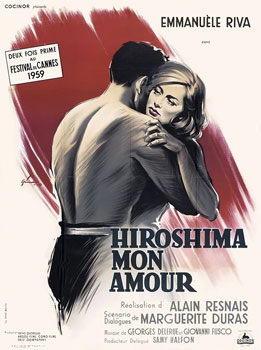
Hiroshima Mon Amour (1959)

Hiroshima Mon Amour is an acclaimed 1959 drama/romance film directed by French film director Alain Resnais, with a screenplay by Marguerite Duras. It is about a relationship between a French woman and a Japanese man. It was one of the first French New Wave films and made innovative use of flashbacks.

Synopsis
Hiroshima Mon Amour concerns the experiences of a French actress (Emmanuelle Riva), referred to as Elle (she), who performs the role of a nurse in a film being shot in post-war Hiroshima. She meets a Japanese architect (Eiji Okada), referred to as Lui (him) and, separated from their spouses, they become lovers. The early part of the film recounts, in the style of a documentary, but narrated by the so far completely unidentified characters, the effects of the Hiroshima bomb on August 6, 1945, in particular the loss of hair and the complete anonymity of the remains of some victims. The man had been conscripted into the Japanese army, and his family were in Hiroshima on that day.