Pages

Wednesday, August 4, 2010

Word to Image: Cinema inspired by poems

curated and notes by Konrad Steiner


Cinema is used here in a response to poetry. These tapes and films were chosen out of the American experimental tradition to exemplify various techniques of marrying the two arts. Poetry as the art of utterence and cinema the art of showing, both whole on their own, don't easily make a good couple. But these film and videomakers have taken up the challenge anyway by responding to the spirit and the letter of the poet, creating an original cinematic writing. Cinema and language meet head on, not unified as in conventional film, but remaining distinct and dancing, stepping on toes, wooing each other with the charms of mouth and eye and mind. You'll see images' own syntax shuffled, blended, chafing and dovetailing with language, you'll hear and read poets' work while seeing and hearing filmmakers' work. It's like having two extra senses!
  • Peter Herwitz, Songs of Degrees: With a Valentine (the 12 February) As To How Much
    Super 8mm, 5min color/sound on cassette (1990)
  • Thad Povey, Under a Broad Gray Sky
    16mm, 5min, color/sound (1995)
  • Rick Hancox, Waterworx
    16mm, 6min, color/sound (1986)
  • Marcus Nascimento, Video Haikai
    video, 8min
  • Nathaniel Dorsky, excerpts from "What Happened to Kerouac?"
    video transfer, 8min

I N T E R M I S S I O N

  • Abigail Child, Prefaces
    16mm, 10min, color/sound (1981)
  • Henry Hills, Kino Da!
    16mm, 4min, color/sound (1981)
  • Martha Colburn, What's On
    16mm, 2min, color sound (1997)
  • Jim Flannery, Photoheliograph
    16mm, 12min, color/sound
  • Stan Brakhage, First Hymn to the Night -- Novalis
    16mm 3min color/silent (1994)"To write 'purely visual perception' is to write a meaningless phrase. Obviously. Because every time we want to make words do a real job of transference, every time we want to make them express something other han words, they align themselves in such a way as to cancel each other out. This, no doubt, is what gives life so much charm. Because it is by no means a matter of awareness, but of vision, of simply seeing. Simply! And the only field of vision that occasionally allows one merely to see, that doesn't always insist on being misunderstood, that sometimes allows its followers to ignore everything in it that is not appearance, the inner field."
    Samuel Beckett, 
    Le Monde et le pantalon, [1945]

Monday, March 22, 2010

Books to Movies: Readers' verdicts

The silver screen and the printed page have been nearly inseparable since the very first black-and-white movies flickered in dark theaters more than a hundred years ago.

And why not?
Novels, short stories and even nonfiction works provide an endless treasure of stories and characters.
That doesn’t mean something isn’t occasionally lost in the translation. For every “Gone With the Wind” or “Lord of the Rings” there’s a “Bonfire of the Vanities.”
So we asked a panel of film buffs and our readers to share their picks of the best and worst adaptations of books into movies.
A sampling of what our readers consider the best and worst movies ever made from books:
The best movie adapted from a book is "The Wizard of Oz" (1939).
Yes, quite a few elements in the movie are different from L. Frank Baum's book (silver slippers anyone?), but the core story of a little girl from Kansas being stranded in a fantasy world of wonder and danger remains.
This movie has stood the test of time and is loved all over the world. When I was a child it would come on only once a year, and I can remember anticipating its arrival almost as eagerly as Christmas morning.
Even when I watched it on my grandmother's ancient black-and-white television --and the movie never turned to color -- it was still a fantastic experience. If you doubt the power of this movie, try watching the eyes of a child seeing it for the first time.

Tuesday, March 9, 2010

Why we just can’t get enough of ‘Alice’

Almost 150 years after its creation, Lewis Carroll’s delightfully weird Wonderland world continues to fascinate — and to spawn merchandise. Jewelry, trinkets, clothing, cosmetics: We want it all.

March 07, 2010|By Adam Tschorn, Los Angeles Times


When Lewis Carroll popped Alice down the rabbit hole in 1865, he had no way of knowing that the girl in the pinafore dress — along with the creatures that populate "Alice's Adventures in Wonderland" and its 1872 sequel "Through the Looking-Glass and What Alice Found There" — would become a permanent fixture on our pop culture landscape.

Alice (Mia Wasikowska) joins the Mad Hatter (Johnny Depp) and the White Queen (Anne Hathaway) in director Tim Burton's Alice in Wonderland.  
Alice (Mia Wasikowska) joins the Mad Hatter (Johnny Depp) and the White Queen (Anne Hathaway) in director Tim Burton's Alice in Wonderland. (Walt Disney Pictures)


The phenomenon encompasses more than the 100-plus versions of the book – the most recent of which, published last month, pairs Carroll's text with illustrations by Camille Rose Garcia and recently hit the Los Angeles Times and New York Times bestseller lists. It's something beyond the more than two dozen feature film incarnations, ranging from a star-studded 1933 version — in which Cary Grant played the Mock Turtle, W.C. Fields was Humpty Dumpty and Gary Cooper, the White Knight — to the Tim Burton take that opened Friday. And it's greater than the nearly dozen TV versions (the most recent a Syfy miniseries that included Kathy Bates as the evil Queen of Hearts who happens to run an emotion-emptying casino and Harry Dean Stanton as a shadowy operative code-named "the Caterpillar").

Saturday, February 27, 2010

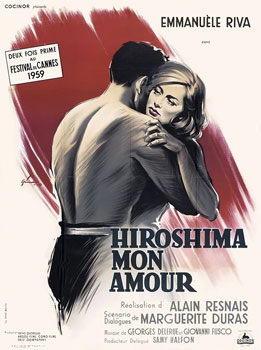
Hiroshima Mon Amour (1959)

Hiroshima Mon Amour is an acclaimed 1959 drama/romance film directed by French film director Alain Resnais, with a screenplay by Marguerite Duras. It is about a relationship between a French woman and a Japanese man. It was one of the first French New Wave films and made innovative use of flashbacks.

Synopsis
Hiroshima Mon Amour concerns the experiences of a French actress (Emmanuelle Riva), referred to as Elle (she), who performs the role of a nurse in a film being shot in post-war Hiroshima. She meets a Japanese architect (Eiji Okada), referred to as Lui (him) and, separated from their spouses, they become lovers. The early part of the film recounts, in the style of a documentary, but narrated by the so far completely unidentified characters, the effects of the Hiroshima bomb on August 6, 1945, in particular the loss of hair and the complete anonymity of the remains of some victims. The man had been conscripted into the Japanese army, and his family were in Hiroshima on that day.

Monday, February 22, 2010

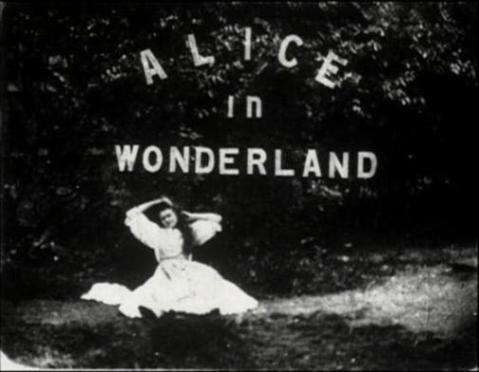
Alice in Wonderland (1903)

The first-ever film version of Lewis Carroll's tale has recently been restored by the BFI National Archive from severely damaged materials. Made just 37 years after Lewis Carroll wrote his novel and eight years after the birth of cinema, the adaptation was directed by Cecil Hepworth and Percy Stow, and was based on Sir John Tenniel's original illustrations. In an act that was to echo more than 100 years later, Hepworth cast his wife as the Red Queen, and he himself appears as the Frog Footman. Even the Cheshire cat is played by a family pet.

Alice's Adventures in Wonderland (Lewis Carroll)


Alice's Adventures in Wonderland (commonly shortened to "Alice in Wonderland") is an 1865 novel written by English author Charles Lutwidge Dodgson under the pseudonym Lewis Carroll. It tells the story of a girl named Alice who falls down a rabbit hole into a fantasy world populated by peculiar and anthropomorphic creatures. The tale is filled with allusions to Dodgson's friends. The tale plays with logic in ways that have given the story lasting popularity with adults as well as children. It is considered to be one of the most characteristic examples of the "literary nonsense" genre, and its narrative course and structure have been enormously influential, especially in the fantasy genre.


to read the full book, click on image below.


Cinematic and television adaptations

The book has inspired numerous film and television adaptations. This list comprises only direct and complete adaptations of the original books. Derivative works and works otherwise inspired by but not actually based on them (such as Tim Burton's 2010 film Alice in Wonderland), appear in Works influenced by Alice in Wonderland.

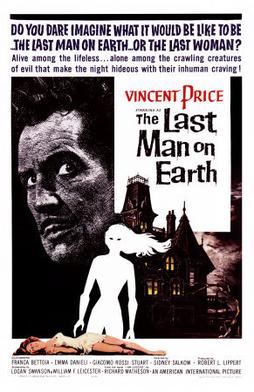
The Last Man on Earth (1964)

Based on the chilling Richard Matheson science fiction classic story I am Legend and later remade as The Omega Man (1971) starring Charlton Heston, and the last one I am Legend (2007) starring Will Smith. 

This classic features Vincent Price as scientist Robert Morgan in a post apocalyptic nightmare world. The world has been consumed by a ravenous plague that has transformed humanity into a race of bloodthirsty vampires. Only Morgan proves immune, and becomes the solitary vampire slayer.


Wuthering Heights (1939)

The earliest known film adaptation of Wuthering Heights was filmed in England and directed by A. V. Bramble. It is unknown if any prints still exist.

The most famous was 1939's Wuthering Heights, starring Laurence Olivier and Merle Oberon and directed by William Wyler.


This adaptation, like many others, eliminated the second generation's story (young Cathy, Linton and Hareton). It won the 1939 New York Film Critics Circle Award for Best Film and was nominated for the 1939 Academy Award for Best Picture.

Wuthering Heights (Bronte Sisters)

Brontë, Emily, 1818-1848; Brontë, Anne, 1820-1849
To read the full book, click on image below.


Nosferatu (1922)

Originally released in 1922 as Nosferatu, Eine Symphonie Des Grauens, director F.W. Murnau's chilling and eerie adaption of Stoker's Dracula is a silent masterpiece of terror which to this day is the most striking and frightening portrayal of the legend.


Sunday, February 21, 2010

Frankenstein (Mary W. Shelley)

To read the full book, click on image.


Frankenstein (1910, Full)

Frankenstein is a 1910 film made by Edison Studios that was written and directed by J. Searle Dawley. It was the first motion picture adaptation of Mary Shelley's Frankenstein. The unbilled cast included Augustus Phillips as Dr. Frankenstein, Charles Ogle as the Monster, and Mary Fuller as the doctor's fiancée.

Shot in three days, it was filmed at the Edison Studios in the Bronx, New York City. Although some sources credit Thomas Edison as the producer, he in fact played no direct part in the activities of the motion picture company that bore his name.

Friday, February 19, 2010

Adaptation Addict: When Is A Movie As Good As The Book? | Airlock Alpha

A comparison between successful remakes and the new Percy Jackson movie helps answer the question.
(This column may contain spoilers for "Percy Jackson & The Olympians: The Lightning Thief")

I like nothing better than taking something like a good book or comic and seeing it well done in another medium. Whether I watch on the television or especially in a movie theater, I sit in absolute anticipation that what I loved in the original will still be there on the screen.

That feeling of adoration that I had for certain characters or interest in a compelling storyline drives me to keep trying again and again. There is nothing better than to walk away from a movie remake thinking that the writers, the director, and the cast absolutely nailed it, or in the case of the Lord of the Rings trilogy movies made it even slightly better.
 

But there is nothing like that feeling of “meh” or even utter disappointment when walking away from a poorly done adaptation. 

A lot of excitement can surround a film adaptation of a good book. There have been some very nicely done film remakes in past years, although I am still on the fence as to how well done the Twilight series is as far as being representative of the books (please don’t send me hate e-mails). However, the second film did do a better job than the first.
 

I think that the Harry Potter series qualifies to be at the top of that list. But what makes that series and other successes work? And what makes others absolutely fail? 

These were the questions that I was considering while sitting through the latest adaptation “Percy Jackson & The Olympians: The Lightning Thief.” 

Many reviewers are calling the new Percy Jackson movie the new Harry Potter, and because of this I anticipated an absolutely fun time like I had when reading the first of Rick Riordan’s book series. I can definitely see the similarities between the two series: it is a coming of age story for a young teenage boy, there are magical powers involved, there are interesting characters, and there is a lot of action.  

While making a judgment on “Percy Jackson,” let’s compare it to what the Harry Potter series does well. 

First of all and maybe most importantly, the Harry Potter series remains very faithful to the books. One of the key reasons is because author J.K. Rowling was very involved in the approval of the scripts. She even steered them away from unfaithful scenes that wouldn’t match the books, like when they wanted to give Dumbledore a girlfriend in a flashback. 

On his official Web site, Riordan admits to having sold the movie rights to Disney more than five years ago and even before the first book was published so that it could get more publicity. This means that the screenwriters for the movie had every opportunity to make changes that they wanted to. That decision may have helped the book and the rest of the five-book series gain the popularity that it now has, but I can bet there were some changes to the basic story that may have made Riordan regret this decision.
 

Unlike Harry Potter where we are introduced to several colorful characters, there were only a few of the major characters present in “Percy Jackson." I don’t know if they think that we viewers are incapable of meeting multiple characters or if the choice was made in the name of streamlining the plot. But there were some characters, albeit not the most important ones, that I missed and that I think will be essential if they choose to film all five of the book series.

More importantly, since Percy is dealing with the Olympians, you would expect him to interact with more than just Zeus, Athena, Poseidon and Hades. In fact, there was a complete omission of Ares and his house at Camp Half Blood.


Speaking of Camp Half Blood, one of the fun aspects of Percy discovering his demigod status and joining everyone at the camp is his placement. Yes, it is very reminiscent of the Sorting Hat at Hogwarts. But at Camp Half Blood, your house is chosen when the god that sired you claims you. One of the things that make an adaptation at least satisfactory if not completely successful is staying true to the basic plot. In order to do this, the writers have to go to the source material and find the important plot kernels that need to stay to maintain faithfulness.
 

In Harry Potter, although there have been plot points that have had to be dropped because of adapting 600-plus pages into a two-hour movie, the basic and most important kernels remain. My biggest complaint about the “Percy Jackson” movie is that they changed the major storyline of the chief gods Zeus and Poseidon not claiming their children, which makes them an anomaly at the camp. The feelings of abandonment and father issues that Percy and other demigods feel make the characters more fascinating.  
Take away the flaws and complications, and movie Percy becomes very flat. Also, if they want to continue the series, the issue of god parenting becomes extremely important. 

I know that in order to make a movie from a book a reasonable length, changes have to be made. Only Peter Jackson was daring enough to take extra scenes that were straight out of the books, film and score them, and add them as extended versions to appease the diehard fans.  

Harry Potter, and now possibly the last Twilight book, took the lengthy last books of the series and split them into two movies in order to do it justice. For a smaller book like “Percy Jackson,” I wonder why they had to make such a major change that ultimately took away from what could have been a film success. 

Was there anything I liked about the movie version of “Percy Jackson”? Absolutely. I liked the actor they chose for Percy, but I bet he could have handled the more complex character of the book. I think that they brought the setting of the book into our modern world very well, although I think that some of the songs that they chose will date the movie in the future, whereas Harry Potter will always seem timeless.  

My favorite part of the movie was the character Grover who I think added even more cheekiness than the character in the book did. But I wonder whether or not they will make more of the book series. If they do, they’ll have to make up for some plot points that they chose to change. 

If I had to choose between the movie or the book, I’m afraid that for “Percy Jackson & The Olympians: The Lightning Thief,” the movie’s deficiencies affect its fun factor. My advice to those that liked the book is to wait for the DVD or reread the book.  


For those who haven’t read the book yet, it’s your choice whether to spend your money at your local bookstore or at the movie theater for this one. However, I am not deterred and will return to the theater for many upcoming adaptations including the updated “Clash of the Titans” and Tim Burton’s vision of “Alice in Wonderland.”

Adaptation Addict: When Is A Movie As Good As The Book? | Airlock Alpha

Tuesday, December 2, 2008

Film version of popular teen novel disappoints


Published: Thursday, November 27, 2008 at 9:00 a.m.

By now I'm sure it's safe to assume that most people have either read at least one of Stephenie Meyers' best-selling "Twilight" series or have at least heard of the phenomenon whose popularity reached a fever pitch in the last few months with the release of the final book in the series, "Breaking Dawn," and film adaptation of the first installment, "Twilight."

William Shakespeare, Screenwriter

Happy 444th Birthday, William Shakespeare, Screenwriter

Let's raise a toast and watch some clips to honor this one-man movie-making machine.
Joseph Fiennes as William Shakespeare in Miramax Films' 'Shakespeare in Love'
Joseph Fiennes as William Shakespeare in Miramax Films' 'Shakespeare in Love' - Miramax Films

Mark Bourne,


With Wednesday, April 23, marking William Shakepeare's birthday, let's all raise a flagon of ale and wish a happy 444th to one of our favorite screenwriters.
Sure, the Western canon's greatest playwright may have lived centuries before movies came along, but he has proved himself time and again as one of our most prolific and popular writers for the big screen. So to commemorate his birthday, let's go to the DVD shelves and find a few of our favorites that ask "What light through yonder movie break?"

Wednesday, October 22, 2008

Don't be stuffy over screen adaptations


28.09.2008
A N Wilson pays tribute to the skill involved in turning books into film
Addicts, not merely of Evelyn Waugh's masterpiece, but also of the 1981 Granada Television version of Brideshead Revisited can only look forward to the new screen version with diluted enthusiasm.

We are told that the new version has Charles Ryder and Sebastian snogging; that the story turns into a "love triangle" between Charles, Sebastian and Julia. Religion is played down. And how could it be Brideshead without Geoffrey Burgon's superb music?

Monday, June 23, 2008

Graphic Novels are Hollywood's Newest Gold Mine


Thursday, Jun. 19, 2008 By REBECCA WINTERS KEEGAN
TIME magazine

Superman Leaped 40 years' worth of tall buildings on the printed page before he landed his first feature film, in 1978. In 2003, Wesley Gibson, the cubicle-dwelling assassin in Mark Millar's nihilist graphic novel Wanted, had producers circling before his first issue even went to print. Millar's work is unlikely source material for a big-budget movie; one of his obscenely named villains is made of fecal matter from 666 evildoers, including Adolf Hitler and Jeffrey Dahmer. Nevertheless, Wanted is now a glossy summer action movie starring James McAvoy, Angelina Jolie and Morgan Freeman, directed by new-to-big-studio-movies Russian Timur Bekmambetov.

Graphic novels--long comic books for grownups--have always had mostly cult appeal. Last year's most successful, the 13th volume in a Japanese manga adventure series--Naruto, by Masashi Kishimoto--sold 80,000 copies, far short of 2007's hottest novel, A Thousand Splendid Suns, by Khaled Hosseini, which sold more than 1.5 million copies. The point of the comics was largely their transgressiveness. "They're the last pirate medium," says Millar, a Scottish writer who consults for Marvel Comics on more mainstream fare, like Iron Man. "They're the last medium for a mass audience where you can do anything you want."

But the creations of oddball loners like Millar scribbling at drafting tables have also become the movie industry's most reliable development tool. Thanks to the box-office success of A-list superheroes like Spider-Man and the X-Men, Hollywood's appetite for comics-fueled material is insatiable. Titles from the darker corners of the genre, including gritty graphic novels like Wanted and Alan Moore's watershed deconstructivist superhero tome Watchmen are getting the big-screen makeover. Stories and characters first written for an audience of a few hundred thousand geeks at most are reaching, at the box office and on DVD and cable, popcorn-chomping crowds that number in the tens of millions. "The dalliance between Hollywood and comics is becoming a marriage," says Frank Miller, creator of the graphic novels Sin City and 300. "The downside is in the heads of people who make comic books. Everybody wants money and fame."

Times weren't always so flush in Toontown. In 1997, "George Clooney killed comic-book movies," says Millar. Joel Schumacher's joyless Batman & Robin, in which Clooney legendarily donned a bat suit complete with rubber nipples, left fans feeling abused. Studios turned their attention to fantasy literature like Harry Potter and The Lord of the Rings. But when Spider-Man bested two wizard movies and a Star Wars prequel in 2002 and X-2: X-Men United broke $200 million at the box office in 2003, hand-drawn heroes swung back into favor. The joke in Hollywood now is that in a risk-averse era, comic-book adaptations have a distinct advantage: the drawings mean studio execs can see beforehand what the movie will look like.

At first, it was the family-friendly superheroes who made the leap to multiplexes, with the help of directors like Bryan Singer and Chris Nolan. Slowly, lesser-known comic books got a shot. Some, like Sin City and Hellboy, became modest box-office successes by adhering to the distinctive spirit of their creators. Others, like Road to Perdition and A History of Violence, attracted audiences with sophisticated stories that few people knew were derived from graphic novels.

Then came the spear that pierced the industries of comics, movies and ab videos: 300. "I was pretty sure we were making a boutique movie," says director Zack Snyder of his R-rated, blood-spattered retelling of the Battle of Thermopylae. With no stars and a lot of leather bikini bottoms, 300 grossed more than $200 million in the U.S. alone. "The movie struck a chord because it was unapologetic," says Snyder, who is directing Watchmen for release next March. "It's difficult to find a movie that feels true to itself. You feel the hand of Hollywood, the moviemaking by committee, on everything."

In the case of 300, the hand audiences felt was really Miller's, since whenever Snyder made a creative decision, he asked himself, What would Frank do? Comic-book-movie directors like Snyder, who see themselves as stewards of another person's vision rather than architects of their own, have made comic-book creators Hollywood's latest big-budget auteurs. Because they work with such low overhead compared with moviemakers, comic writers and artists can take many more creative chances than directors. "You don't have endless development meetings that turn your brain into milk," says Miller. "You get to at least see what an individual has to offer." After co-directing Sin City with Robert Rodriguez in 2005, Miller is completing his comics-to-movies arc by directing The Spirit, an adaptation of a 1940s crime-fighting strip, for a December release.

The other axiom 300 proved to Hollywood is one the comics industry has known for decades: "The audience for comic-book movies is overweight guys in their mid-30s," says director, comic-book-store owner and overweight guy in his late 30s Kevin Smith. Actually, the average age of a comic-book buyer is 23, but Smith's point--that there are fans aplenty to support R-rated comics franchises--has been digested. Even PG-13 comic-book movies are maturing. Batman keeps getting darker scripts, like Nolan's The Dark Knight, starring Christian Bale and Heath Ledger (in his haunting last performance, as the Joker). Marvel Studios' first two movies, Iron Man and The Incredible Hulk, star Robert Downey Jr. and Ed Norton, Oscar-nominated actors with indie credibility. And Hellboy, who is back this summer for a sequel, is hardly your standard man in tights. He smokes cigars, drinks Red Bull and collects kittens. "Kids aren't kids anymore," says Hellboy creator Mike Mignola. "They're so exposed to everything. They wouldn't accept really simplistic superheroes." It's likely that a superhero movie like Watchmen or The Dark Knight couldn't be appreciated by audiences without the simpler fare that came before it. You can't deconstruct the superhero until someone has constructed him, rubber nipples and all. "Watchmen is thick and complicated and violent and political and critical of America," Snyder says. "It's huge."


to read full article please click


Film Semiotics: A Metalinguistic Analysis


A language, by definition, is a semiotic process through which thought may be conveyed, but a language system (or linguistic system) enables a response to that thought using the degrees and kinds of signs and signifiers produced by the language. Film uses not only words, but also different kinds of shots, angles and speeds; therefore, while the audience can react to a film's semantic intent, that audience cannot address its concerns regarding the film in the same language the film used to convey its argument. For that reason, Robert Stam, Robert Burgoyne, and Sandy Flitterman-Lewis advance Christian Metz’s argument that while the means by which film expresses itself to its audience constitutes a language, it cannot constitute a linguistic system. Metz argues that


one might call ‘language’…any unity defined in terms of its matter of expression…Literary language, in this sense, is the set of messages whose matter of expression is writing; cinematic language is the set of messages whose matter of expression consists of five tracks or channels: moving photographic image, recorded phonetic sound, recorded noises, recorded musical sound, and writing…Thus cinema is a language in the sense that it is a ‘technico-sensorial unity’ graspable in perceptual experience. (37)

The language of cinema, as a result, cannot be answered by the language of literature because the two systems use different modes of expression. In support of this point, Raymond Bellour argues that film is the "Unattainable Text":


the film-text, unlike the literary text, is not ‘quotable.’ Whereas literature and literary criticism share the same medium – words – film and film analysis do not. While the film medium entails five tracks – image, dialogue, noise, music, written materials – the analysis of the film consists of a single track – words. Critical language is therefore inadequate to its object; the film always escapes the language that attempts to constitute it. (56)

To appropriately respond to a film, consequently, one would have to generate a film of his or her own using the same methods employed by the director in a manner dialogic to the film being addressed, and this is problematic for most of the viewing audience. In spite of our inability to respond to a film in its language through natural means of discourse, understanding the nature of film semiotics makes us critically aware of the language being used, and that results in an enhanced understanding of the way in which film is representative of cultural and counter-cultural values.
The book is divided into five parts, the first of which develops the terminology and history of semiotics in a chapter entitled "The Origins of Semiotics." It begins with an introduction of two seemingly interchangeable terms: semiology and semiotics. The former is defined by Ferdinand de Saussure as:


A science that studies the life of signs within society is conceivable; it would be a part of social psychology, I shall call it semiology (from Greek semeion ‘sign’). Semiology would show what constitutes signs, what laws govern them. (Course in General Linguistics 4)

The latter is derived from Charles Sanders Pierce, who proffered a similar definition of the term (4). Regardless of this semantic distinction in terminology, Stam et al. explains that the "sign is for Saussure the central fact of language, and the primordial opposition of signifier/signified constitutes the founding principle of structural linguistics" (8). The dichotomy between these two is reconciled in the following formula:


The identity of any linguistic sign is determined by the sum total of paradigmatic [involving choosing] and syntagmatic [involving combining] relations into which it enters with other linguistic signs in the same language system. (9)

The Paradigmatic is defined as "a virtual or ‘vertical’ set of units which have in common the fact that they entertain relations of similarity and contrast," and the Syntagmatic4 deals with "the sequential characteristics of speech, their ‘horizontal’ arrangement into a signifying whole" (9). This formula loosely resembles the linguistic system of Tagmemics, wherein diction and syntax are construed in a slot-plus-class (syntagm-plus-paradigm) relationship, which enables them to be better understood in their functional grammatology.
The use that Stam makes of this in its relationship to cinematic forms lies in the concept of translinguistics, which entails a "theory of the role of signs in human life and thought" (13), in that signs have multiple significances depending on the views of conflicting classes. This multi-accentuality4 is "the capacity of the sign to elicit variable social tones and ‘evaluations’ as it is deployed within specific social and historical conditions" (13). In contrast to Saussure’s structuralism, Derrida proposed a vision that went beyond it--post-structuralism. This line of thought "demonstrated a thoroughgoing distrust of any centered, totalizing theory, a radical skepticism about the possibility of constructing a metalanguage which might position, stabilize or explain all of the other discourses, since the signs of the metalanguage are themselves subject to slippage and indeterminacy" (23). By entailing "a critique of the concepts of the stable sign, of the unified subject, of identity and of truth" (23), post-structuralism


exists in both continuity and rupture with structuralism. It shares the structuralist premise of the determining, constitutive role of language, and generally continues within the structuralist problematic, especially the assumption that signification is based on difference. At the same time, it rejects structuralism’s ‘dream of scientificity,’ its hopes of stabilizing the play of difference within an all-encompassing master-system. (27)
The Saussure-Derrida disagreement’s significance to film is discussed in the second chapter entitled "Cine-Semiology," in which Christian Metz is introduced by way of transition.


The question which oriented Metz’s early work was whether the cinema was Langue (language system) or Language (language) and his well-known conclusion…was that the cinema was not a language system but that it was a language. (34)

His argument is that "langue is a system of signs intended for two-way communication, while the cinema allows only for deferred communication" (34). In today’s world, however, this assertion will eventually have to be rethought because it does not allow for interactive cinema (like porn chatrooms) or Internet conference calling where role play is being done by either party—either of which can technically be considered film-making, especially if the parts of dialogue and imagery are manipulated to produce a contrived result. Metz further argues that cinema is not a language system because "it lacks the equivalent of the arbitrary linguistic sign," replacing it instead with a ‘motivated’ sign. So, the relationship between signifier and signified differs from literature to film (35). Metz argues against the idea that the camera/cinematic shot is like the word while the sequence is like the sentence. He states as evidence that "(1) shots are infinite in number…(2) shots are the creations of the film-maker…(3) the shot provides an inordinate amount of information…(4) the shot is an actualized unit [meaning that it generates an exact representation of its intended meaning]…(and) (5) shots, unlike words, do not gain meaning by paradigmatic contrast with other shots that might have occurred in the same place on the syntagmatic chain" (35-6). Also, cinema "does not constitute a language widely available as a code" (35), for while all speakers of English can produce English, not all can produce the talent, training and access produced by filmic utterances (35). Again, this would have to be qualified in respect to advances in technology that put Internet cameras on everyone’s desktops or enabled lightweight camcorders to be used in independent film-making efforts like The Blair Witch Project. Stam argues further that language and film are both discursive "through paradigmatic and syntagmatic operations" (37).


Language selects and combines phonemes and morphemes to form sentences; film selects and combines images and sounds to form syntagmas, i.e. units of narrative autonomy in which elements interact semantically. (37)

The idea that there was one grand syntagmatic code, moreover, was refuted by others who argued that he was setting up a system too rigid to be viable. In response, Metz modified his argument to allow room for other cinematic codes. Stam explains that


like any artistic language, the cinema manifests a plurality of codes. In cinema, numerous codes remain constant across all or most films; unlike language, however, film has no ‘master code’ shared by all films. Filmic texts, for Metz, form a structured network produced by the interweaving of specific cinematic codes, i.e. codes that appear only in the cinema, and non-specific codes, i.e. codes shared with languages other than the cinema. (48-9)

The sense Metz makes of these codes, to give meaning to the plot of any given film, is discussed in the third chapter entitled "Film-narratology." Within this chapter, Stam explains the means by which the idea of a lengthy feature film is sold to an audience.


Metz argued that the organization of images into a narrative was one of the most important ways that film was like a language. The Grand Syntagmatic sought to designate and classify the specifically narrative segments of film language, which Metz understood in terms of sequences of shots, called syntagmas. These eight syntagmas [see footnote above], which were distinguished primarily through editing, expressed the spatial temporal and logical connections that form the universe of the fabula. (79)

Implicit in the need for a cohesive plot structure driven by a recognizable and powerful theme lies the necessity for these syntagmas to be sutured, or stitched, together in a way that enhances the flow of the film and generates the realism necessary for the audience to maintain credulity. The way in which those shots are sutured together is another form of communication between the film and its audience, but it is not a dialogue any more than the actors on the screen are influenced by the mood of the spectators sitting in the theater5. By choosing how to cut the story the film is trying to relate to the viewer, the director decides how that story is going to speak to the outside world.
That the outside world responds to film in a certain way is predicated upon its having been pre-conditioned through an innate desire to find the self in the gaze of the other. The fourth chapter, entitled "Psychoanalysis," describes one of the aims of psychoanalytic film theory as "a systematic comparison of the cinema as a specific kind of spectacle and the structure of the socially and psychically constituted individual" (123). Stam explains


If psychoanalysis examines the relations of the subject in discourse, then psychoanalytic film theory meant integrating questions of subjectivity into notions of meaning-production. Moreover, it meant that film-viewing and subject-formation were reciprocal processes: something about our unconscious identity as subjects is reinforced in film viewing, and film viewing is effective because of our unconscious participation. Moving from the interpretation of individual films to a systematic comprehension of the cinematic institution itself, some film theorists saw psycho-analysis as a way of accounting for the cinema’s immediate and pervasive social power. For them the cinema ‘reinscribes’ those very deep and globally structuring processes which form the human psyche, and it does so in such a way that we continually yearn to repeat (or re-enact) the experience. (124)

The idea that individuals can be influenced by films that mirror their latent desires within a broad range of their birth culture is interesting in the sense that it defines the culture as the macrocosm of the individual. It further seems to explain the voyeurism and vicarious living undergone by each audience member who sits alone surrounded by a crowd of other people who are alone, too. Theaters, therefore, are not social gathering places in the sense of a community’s coming together to enjoy a shared experience. They are, rather, places in which the lone individual, even if surrounded by his or her friends, can experience nascent predilections and explore formative moments within or outside of the safety of his or her own cultural norms. Spectators are able to do this as individuals either because they have already developed beyond the confines of their own understanding of the world and, therefore, are open to the suggestions of others that lay outside their realms of experience, or because they have yet to grow beyond their earliest attachments and rediscover those within the context of film.
This idea of the self as both a part of culture and as an autonomous unit with a very specific inner sense of identity helps us recognize the effect any given sequence of images may have upon us and distinguish the roles played by those images in relation to dominant cultural values. The book concludes with a chapter entitled "From Realism to Intertextuality," which lists the Comolli and Narboni taxonomy of the possible relations between a film and the dominant ideology of the culture in which the film was made. These include:


1) Dominant films, i.e. those films thoroughly imbued with dominant ideology

2) Resistant films, which attack the dominant ideology on the level both of the signified and of the signifier

3) Formally resistant films, those films which, while not explicitly political, practice formal subversion

4) Content-oriented political films, explicitly political and critical films...whose critique of the ideological system is undermined by the adoption of dominant language and imagery

5) Fissure films, i.e. films which superficially belong to dominant cinema but where an internal criticism opens up a ‘rupture’

6) Live cinema I, i.e. films depicting social events critically but which fail to challenge the cinema’s traditional ideologically conditioned method of depiction

7) Live cinema II, direct cinema films which simultaneously depict contemporary events critically and question traditional representation (196)

In each of these film types, there is a means for the spectator to either identify with or rebel against the image offered. The choice the movie offers is not necessarily compatible with the spectator’s ability to answer back with the language of the ideology, just like there is no possibility of the spectator’s being able to answer back in the language of the cinema. However, the spectator’s reaction to those choices helps that spectator define his or her place in that culture in comparison to or contrast with the values being witnessed. The signs and signifiers of the film media can, therefore, be accessed and responded to even though they engage the audience in a language the audience itself cannot speak.
Works Cited


Stam, Robert, Robert Burgoyne, and Sandy Flitterman-Lewis. New Vocabularies in Film Semiotics: Structuralism, Post-Structuralism and Beyond. New York: Routledge, 1992.

Monday, March 31, 2008

Visitors by countries


Visitors by countries (provided by Sitemeter)

Saturday, March 22, 2008

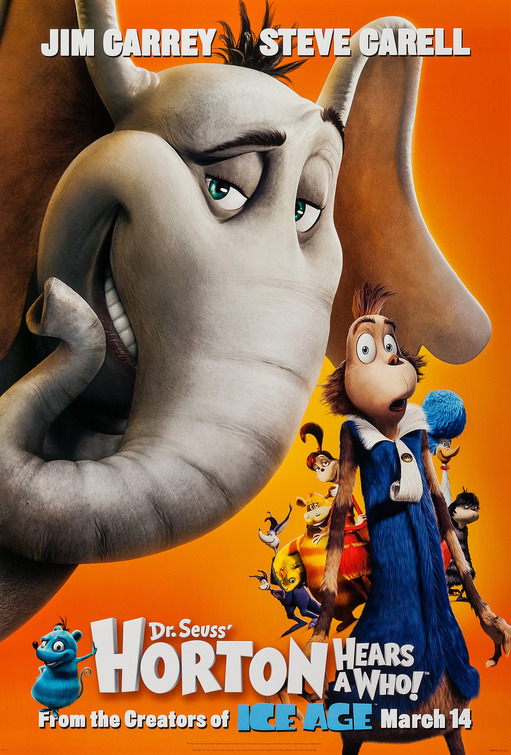
Movie adaptations of Dr. Seuss stories

Horton captures imaginations and Seuss' vision

Rameez Anwar

Issue date: 3/21/08

After the last two movie adaptations of a Dr. Seuss story - the forgettable How the Grinch Stole Christmas and the abominable The Cat in the Hat - it had become a legitimate concern as to whether it was possible to successfully convert one of Seuss's concise classics into a full-length film. However, Hollywood's latest attempt, Horton Hears a Who!, makes the prospect of a big screen Green Eggs and Ham much less frightening. While the movie is legitimately entertaining, and not even in a "so bad it's kind of good" way, it flags in energy whenever it strays from the concept of the original story and focuses on uninspired plot additions.

For the most part, the film focuses on Dr. Seuss' original plot: Horton the elephant (The Number 23's Jim Carrey) discovers a microscopic world on a speck of dust, befriends the mayor of tiny Whoville ("The Office"'s Steve Carell) and then embarks on a journey to find a safe place to store the speck of dust.

In addition to its faithful rendition of the original plot, the movie's vibrant animation excellently captures the tone of Seuss' trademark whimsical illustrations. The live-action adaptations of Seuss' work had neutered this essential quality with pounds of creepy makeup and expensive but drab set pieces. The success of Horton's visual style seems to indicate that Seuss' magic works best in a cartoon format.


Another aspect of the movie that separates it from The Grinch and The Cat in the Hat is its refusal to allow the story to be hijacked by any of its performers. Jim Carrey tones down his act to create a sweet and sometimes funny character without overstaying his welcome.


The voice acting in general is well done, with notable performances coming from Carell and from Will Arnett ("Arrested Development") as the vulture mercenary, Vlad.

The movie only temporarily loses its way whenever it forays into the subplots added in order to extend a 10-minute read into a 90-minute movie. For instance, the plotline involving the miscommunication between the mayor and his only son (out of 97 children) is clichéd and never really gets resolved.

Besides adding these ill-advised plot devices, the movie's only other shortcoming is that it never really strikes an appropriate balance between entertaining both children and adults. For a cartoon like Horton, keeping parents and nostalgic college students from groaning or falling asleep in their seats should be subservient to the primary goal of entertaining children. However, most of the laughs in the theater were coming from the adults, while the kids often sounded confused. That isn't to say they were never laughing; on the contrary, most of the kids seemed to enjoy the movie quite a bit, judging by the looks on their faces as they exited the theater. But it often seemed like there was a chorus of "huh?" accompanying the film's soundtrack.

Overall, Horton Hears a Who! is the best of the three recent Dr. Seuss adaptations. The general adherence to the original plot, engaging but never over-the-top voice acting and lively visuals easily offset the movie's few shortcomings.